Indian Village Tour
Duration : 18 Nights / 19 Days
Places to See : Delhi - Agra - Jaipur - Mahansar
- Falodi - Jaiselmer - Mt Abu - Zainabad - Bhuj - Kutch - Ahmedabad - Delhi
Most of the Indian people lives in villages. Even though there are large industrial
sectors in India and a alargenumber of people work in government departments,
biggest chunk of population resides in small town and villages. These villagers
are dependent on farming for their livelihood. It is in these villages you see
and watch real India. These are the very people who have kept the tradition
s alive. Fesstival religious or otherwise make an important part of village
life. Traditional arts and crafts and most of the villages have their own Textile,
pottery and craft producing families. These families are not farmers but trade
their goods with villagers.
Trip takes you from the villages of Northern India right through to the villages
in westernmost part of India Runn of Kutch in Gujrat. You pass through these
villages watching and understanding the complex life style of the people who
live there. You also get an unhurried look at how villagers produce and enjoy
arts and crafts of Rural India.
Main forms of Arts and Crafts include the followings
:
Sculpture and miniature painting
Pottery
Printing and Embroidery
Wood Carving
Stone carving and metal work
In brief it is a treat to see such a vibrant form of art and craft in village
India, which is an expression of it’ people life. Though all these art
forms are important, textile playas major part in the life of Indian people.
Brief history of Indian Textile :
The art of dyeing and cotton printing originated in India over two thousand
years ago. Indigo, Madder and cotton plants were found in abundance and were
used by locals to produce colourful materials. Indigo was the natural source
or colour blue and madder was used to give red colour.
In 1600 East India company started importing Indian textile known as indigenes,
perses, calicut,pintadoes, and chintz. These were printed, painted and decorated
in elaborate stles emplying printing and resist dyeing. Until this time in
England, clothing was rather dull and heavy, made of linen, hemp and woll
and patterned with somber colours.
Tapestries and woven silks were of course richer but there were no handsome
and lightweight materials for ladies. The imported textile from India and
east were an immediate sensation.
There were colourful and pretty with delicate patterns of exotic flowers, birds
and dyes were fast. This demand grew to such proportion that 1700 British Parliament
was forced to prohibit the imported textiles.
Indian cotton clothes were initial inspiration, which led to momentous technical
achievements and to industrial revolution in England; Te clothes thus produced
were eagerly sought by the west and made in to the graceful becoming dresses
of the eighteenth century.
The great colour belt in India, which is identical with the great printing
belt extends from the interior of Sindh through the desert of Kutch, Kathiawar
and Rajputana to the border of Gujrat. It is if the fierce sun and bleak stretches
of sand have demanded compensation in the deep brillian clours clothing. Colours
seem to be roasted and matured by the sun. They form a vital part of the background
dictated by urges inherent in the environment and the character of people.
As we go further south colours loose their brilliance, they become darker
and more subdued. The whole of the vast colour belt is studded with printing
centre and a tradition of resists dyeing that stretches back a thousand years.
IN some areas practically every villages has its own variation of design colour
and technique.
Day
01 : Arrive Delhi
Overnight Hotel.
Day 02 : Sightseeing of Delhi
Home hosted dinner.
Day 03 : Morning drive to Agra
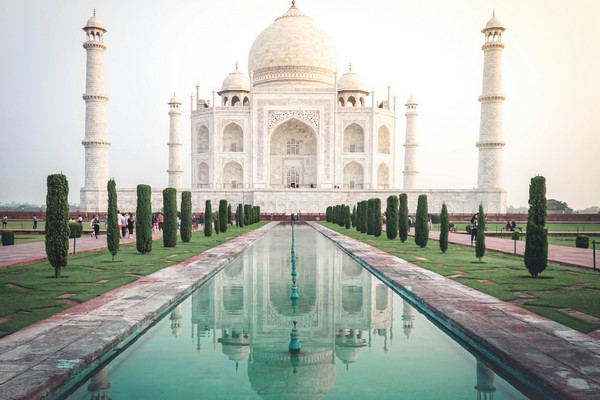
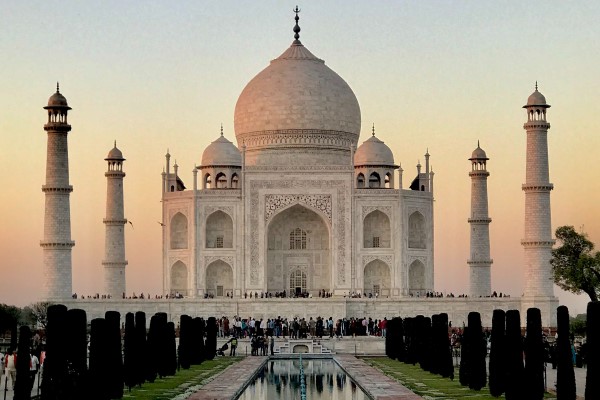
Afternoon visit to Taj and Agra Fort.Overnight Hotel.
Day 04 : Drive to Jaipur
Enroute visit Fatehpur Sikari. Overnight at Hotel .
Day 05 : In Jaipur
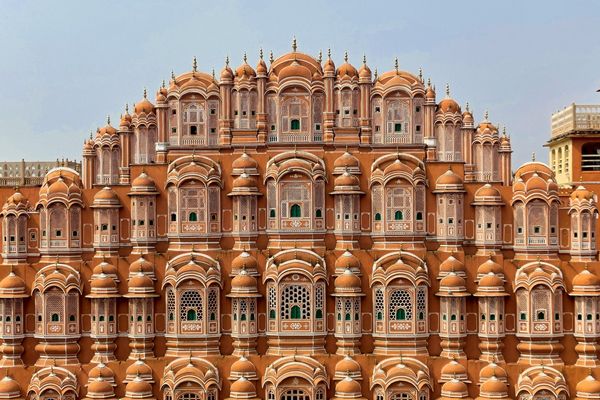
Day is spent visiting City Palace, Observatory and Palace of Wind ( Hawa Mahal).
WE will also visit places of Block Printing Blue Pottery, Overnight at Hotel.
Day 06 : Jaipur
This after breakfast you will visit Amber Fort and continue driving to Mahansar.
Mahansar has a small castle, which has been converted in to a hotel. You will
be Spending overnight at this place. Afternoon walk through the village and
visit local mansions famous for murals and frescoes.
Day 07 : Drive to Falodi ( 4 hours)
Today after breakfast drive to Falodi.( 4 hours) . Afternoon visit to Jamba
village famous for its Bishnois villagers, believe in preserving all life forms
including trees. It will give you a chance to have closer look at village life
and a visit to Jambo je the diety this village is named after.
Day
08 : Drive to Jaiselmer ( 4 hours)
Overnight at Hotel.
Day 09 : Jaiselmer
Explore the city of Jaiselmer on foot.
Day 10 : Drive to Barmer( 4 hours)
Famous for woodcarving, woolen carpets, and Embroidery works. Over night at
Hotel.
Day 11 : Drive to Mt Abu ( 7 hours)
Overnight at Hotel.
Day 12 : In Mt Abu
Visit Dilwara Jain temple, Nakki Lake. Overnight at Hotel.
Day 13 : Drive to Zainabad ( 8 hours)
A small town on the edge of little Rann of Kutch.
Day 14 : Drive to Bhuj
Overnight at Hotel.
Day
15 & 16 : Bhuj
Explore the different aspect of Kutch Handicarfts wich
include the following :
Embroidery of many kinds on fabric
Leather embroidery
Hand block printing
Tie and dye
Artistic cotton and wollen weaving
Mushroo weaving
Wollen Namda
Wood work
Terra cotta
Silver work and jewellery
Sea shell toys
Day
17 : Drive to Ahmedabad ( 7 – 8 hours)
Overnight at Hotel
Day 18 : Ahmedabad
Visit Calico Museum etc. Overnight at Hotel.
Day 19 : Departure
Fly to Delhi or Mumbai and onwards.
Indian Village Tour Reservation Form