Jodhpur Tour
Duration:
07 Nights / 08 Days
Destinations:
New Delhi - Jodhpur - Siana - Jodhpur - Delhi - Agra - Delhi
Day 1 :
New Delhi
Arrive New Delhi and met by our representative at the airport and transferred
to the Hotel. Morning relax. Post Lunch start your city sight seeing
with visit to the Old City of Delhi to see the historic Red Fort and the
Jama Masjid, India's largest mosque from the outside. See the colourful bazaar
of Chandni Chowk and take a cycle rickshaw ride through the back streets of
Old Delhi to get a first hand experience of the hustle and bustle of this traditional
city. This ride through the small by-lanes will be most fascinating.
Red fort
It was built by Mughal Emperor Shah Jahan. It took 10 years from 1638-48 &
about nine crores of rupees ( 90 million ) to complete it. It is made of red
stone which perhaps has imported it it's name. The fort house several historical
buildings done under the reputed architect Muramat Khan Some chief sights
within the fort are, Delhi Gate, Lahori Gate, Meena Bzaar, Justice Court, Hamaams
Buraj, Moti Masjid, Hayat Bux Garden, Sawan Bhadon, Zaffer Mahal, Sah Buraj
& Museum etc. Every evening light & music ( Son et Limmerie ) shows
are exhibited at Red Fort.
India Gate
Located on the eastern end of Rajpath this memorial was built in memory of martyrs
of the 1st World War. Sir Lutyeus was the architect of this 42 meters high monument.
it's construction was begun in 1921 & took 10 years to complete it. A gun
& Helmet is displayed in the middle of this gate while a perpetually buringflame
keeps playing homage to the wars martyrs, and drive past Rashtrapathi
Bhawan - the residence of the President of India, which is flanked by the houses
of Parliament and the Government Secretariat buildings.
Humayun's Tomb
Privileged to be assigned as a World Heritage site by UNESCO, this tomb was
believed to be designed by Haji Begum, Humayun's Persian widow in the mid 16th
century, shortly after his death in 1556. The tomb was an important predecessor
of Mughal mausoleums. The 'Garden Tomb' as it is popularly called, is set amidst
a geometrically planned garden with a number of water channels crisscrossing
it. Typically, a Persian garden that would later be seen in the Red Fort of
Delhi and Taj Mahal of Agra, its architectural form and especially its main
chamber bears familiarity with the tomb of the Mongol Ilkhanid ruler of Persia,
Oljeytu, at Sultaniyya, which in turn was influenced by Timurid architecture
of the tomb of Timur (Tamerlane) in Samarkand, the lineage of Babur.
The first Indian building to use the Persian double dome, Humayun's tomb is
harmonious in its proportions and has some impressions of Indian architecture
that are clearly visible in the small kiosks or chhatris on the roof. The building
has beautiful inlaid tile work and intricately carved stone screensThis is surrounded
by a garden of Mughal days & several Mughal dignitaries had also been buried
here.
Qutab Minar
This tower is 73 meter tall. According to a school of thought it was built by
Prithvi Raj Chauhan who had it called ' Prithvi Laat ' , i.e. Prithvi Tower.
But in AD 1200 when Qutubuddin Aibak successed in establishing Muslim rule in
India the transformed Prithvi Tower into victory tower naming Qutab Minar after
his name. He had incorporated in it beautiful Afghan architecture. Its first
storeys are built with red-sand stone whie next 2 are built in marble.It's fist
section was launched by Qutubuddin Aibak & the remaining section was completed
after his death by his son-in-law & successor Sultan Altanush in AD 1236.
The radius of this tower at its ground level is 14.32 meteres which tapers to
2.75 metres at its top. Beautiful decorations are inscribed with in this tower
which surprise the on lookers. It iss situated 15 kms south of Delhi &
is visible from afar.
Day 2 : New Delhi to Jodhpur
Morning after breakfast transfer to airport to board a flight to Jodhpur. On
arrival meeting and assistances at airport and transfer to hotel Hari Mahal
Palace. Overnight in Jodhpur
Jodhpur
This bustling desert city is the second largest city in Rajasthan after Jaipur
and has landscape dominated by the massive Meherangarh Fort topping a sheer
rocky ridge.
The old city is fenced by 10 km long wall with eight Gates leading out of it.
The new city is outside the walled city. Rao Jodha, a chief of the Rathore clan,
founded the city in 1459 and it is named after him.
Place to visit in Jodhpur
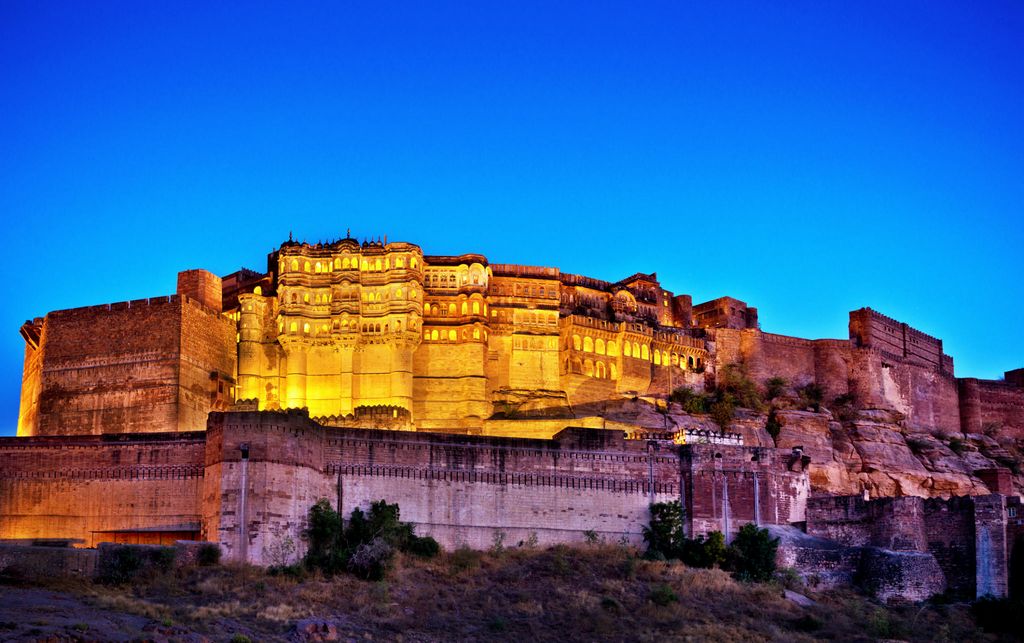
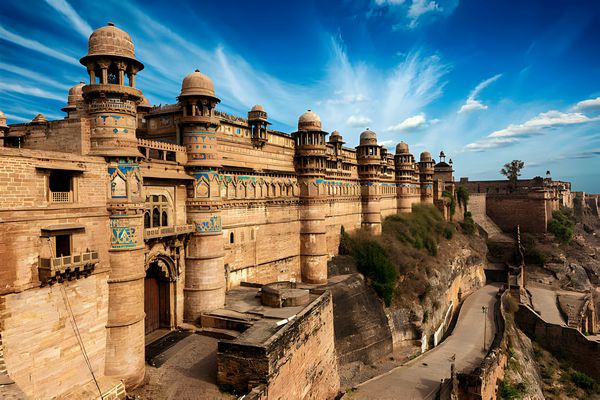
MEHRANGARH
FORT
Perched on a 150 m high hill its sprawl is the most formidable and magnificent
fort in Rajasthan. Rao Jodha founded it in 1459 but subsequent rulers of Jodhpur
have also added to it over the centuries. A meandering road leads to the from
the city 5 kms below. Battle scars of canon ball hit by attacking armies of
Jaipur can still be seen on the second gate. To the left is chhatri of Kirat
Singh Soda, a soldier who fell on the spot while defending the fort against
the armies of Amber. There are seven gates, which include Jayapol meaning victory
built by Maharaja Man Singh to commemorate his victories over Jaipur and Bikaner
armies. Fattehpol also meaning victory gate was built by Maharaja Ajit Singh
to mark the defeat of Mughals. The palm imprints still attract devotional attention
and are covered by vermilion paste and paper-thin silver foil.
JASWANT THADA
On the way down from the fort, on left is Jaswant Thada, the graceful marble
cenotaph of Maharaja Jaswant Singh II. His son Maharaja Sardar Singhji built
the Taj Mahal of Marwar in the memory of Maharaj Jaswant Singhji II of Jodhpur.
The main memorial has been built like a temple with intricately carved marble
stone that is sculpted by the genius artesian. A visit to this structure is
through the rocky hills giving it a secluded and a mystic aura
UMAID BHAWAN PALACE
Maharaja Umaid Singhji who built this palace was fascinated with western lifestyles
so he marshalled the services of a well-known Edwardian architect, Henry Vaughan
Lanchester, a creditable equal of Edward Lutyens (architect of New Delhi) to
construct a three hundred and forty seven roomed Umaid Palace. This was to become
India last of the great palaces and the biggest private residence in the world.
Spectacular Central Rotunda, the cupola rises to a hundred and five feet high;
the Throne Room with its exquisite Ramayana murals; an elegant wood-panelled
library, and even a private museum; an indoor swimming pool, a Billiards Room,
tennis courts and unique marble squash courts makes Umaid Bhawan Palace is unabashedly
the most magnificent. The palace was also built with superficial intentions
of providing employment to famine stricken farmers. The Palace now is a five
star deluxe palace hotel. The museum of the palace is highly recommended for
its display of weapons, an array of stuffed leopards, a huge banner presented
by Queen Victoria and an incredible collection of clocks.
Day 3 : Jodhpur to Siana
Morning after breakfast drive to Siana 175 kms ( 3 hrs ) On arrival check in
to Siana Camp. Overnight in Camp.
Siana is a small hamlet situated in south west Rajasthan, bordering the
great Thar desert. The terrain here is a unique mixture of Aravalli hills bordered
by sand dunes and agricultural lands. The run-off from these hills has created
picturesque ravines in these dunes and has carried this sand into neighbouring
countryside making this area perfect for riding. The south west part of Rajasthan
is still untouched by western influence and offers a good insight into the traditional
way of life. The rock formations in the Aisrana Range need a special mention
as they are unique and wonderful to watch against the backdrop of the setting
sun.
Siana would be an ideal destination for those seeking adventure in form
of safaris and at the same time wishing to get an insight into untouched rural
Rajasthan. It is not just a ride from one place to another but rather a complete
insight into rural southwest Rajasthan.
This part of Rajasthan has remained cut off from the tourist circuit and as
a result retains its traditional charm. The small Shepard villages that one
passes through still retain their originality in terms of housing structures,
attires and social customs. There are no forced smiles to welcome the foreign
tourist. Riding becomes the means through which one views the culture as well
as the wildlife of this region.
Highest appreciation has been received for the terrain of this region. It is
a beautiful combination of semi-desert countryside, dunes & ravines bordering
small offshoots of Aravalli Ranges, sandy plains & agricultural lands where
underground water exists. There is no monotony of riding the same terrain everyday.
Also worth mentioning are the rock formations in the small hills that one rides
by. These rock formations are particularly picturesque to watch against the
setting sun.
Day 4 to 5 : In Siana
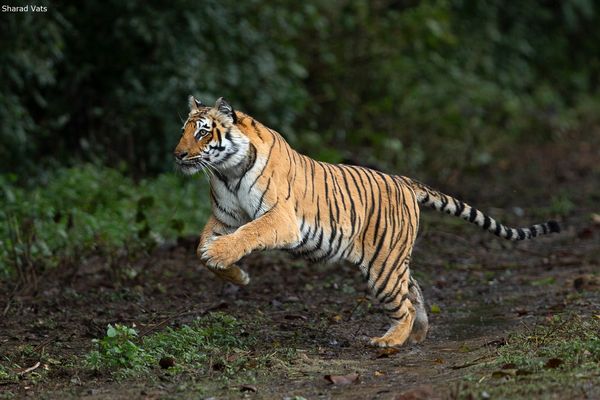
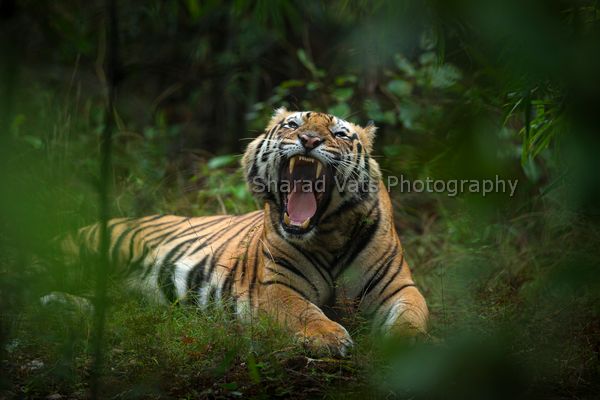
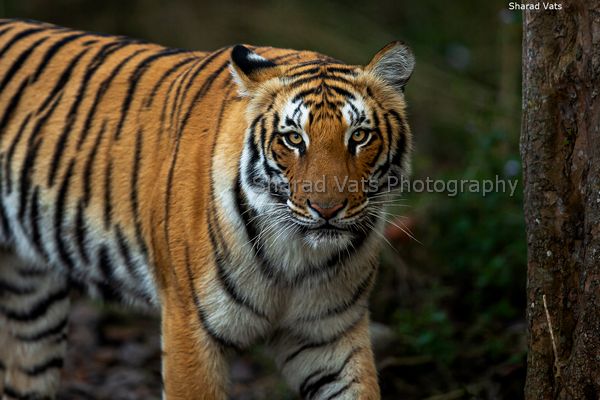
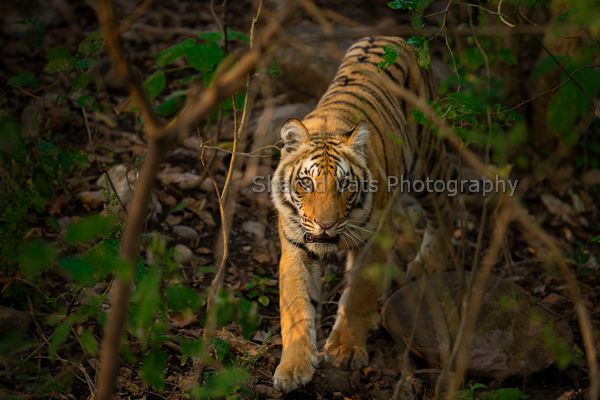
Breakfast, lunch & dinner at Camp and during the stay Leopard safari
& bird watching by open jeep. For generations Siana family have maintained
their own stables and stud farm, with the result all the horses used today are
from the home stables. The tradition of breeding marwari horses continues even
today.The horses used are marwari breed of horses and are a perfect match for
the terrain in which they are used. This breed of horses is local to the area
and is ridden unshod as the soft terrain offers cushioning to the hoofs. Most
importantly all horses are from our own stable and hence tolerate each other
very well. All horses are well trained and the tack used is English. Camel Ride
also available at camp
Siana is a small hamlet situated in south west Rajasthan, bordering the great
Thar desert. The terrain here is a unique mixture of Aravalli hills bordered
by sand dunes and agricultural lands. The run-off from these hills has created
picturesque ravines in these dunes and has carried this sand into neighbouring
countryside making this area perfect for riding. The south west part of Rajasthan
is still untouched by western influence and offers a good insight into the traditional
way of life. The rock formations in the Aisrana Range need a special mention
as they are unique and wonderful to watch against the backdrop of the setting
sun.
Day 6 : Siana to Jodhpur to Delhi
Morning after breakfast drive to Jodhpur to board a flight to New Delhi. On
Arrival transfer to hotel and overnight at New Delhi.
Day 7 : New Delhi to Agra to Delhi
Early morning board a A/C Chair Car Train to Agra. Reach Agra at 0800hrs meeting
& assistance and start city tour of Agra. Lunch at Hotel Taj View
.
Agra had been the chosen city of Mughals for years as it was close to
Delhi. However, the history of Agra is much more older than the times of Mughals.
The great Hindu epic 'Mahabharat' refers to 'Agraban' as an integral part of
the Brij Bhumi or the land of Lord Krishna. It is claimed that this was the
region of Agra, covered by forests then. However, the city is said to be founded
in 1475 during the reign of Raja Badal Singh. Mughal monarchs transformed the
land into one of the great centres of art, culture, learning and commerce. Massive
monuments, majestic buildings and still flourishing arts and crafts including
leatherwork and pietra dura marble-inlay work along with delicious Mughal cuisine
have now become an inseparable part or more, the identity of the city
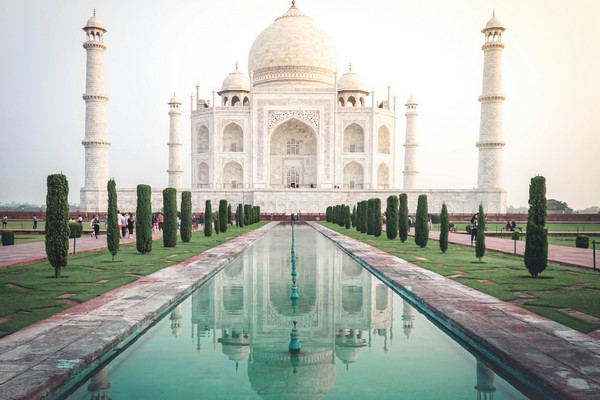
Taj Mahal
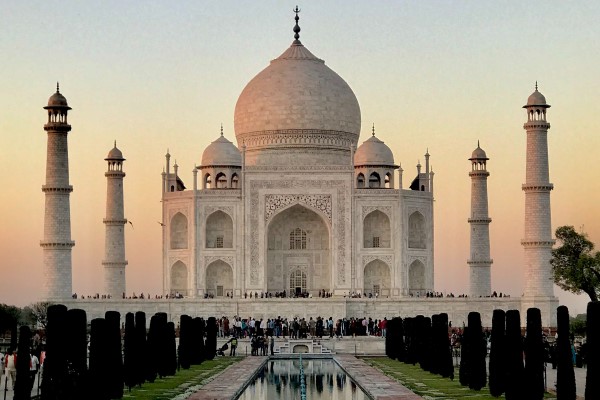
The source of the name 'Taj Mahal' is not very clear but scholars believe that
it originated from the abbreviation of the empress' name, Mumtaz Mahal and translated
to 'Crown Palace'. As the small details integrate together, one is awed by the
costliness and large quantities and finery of the materials used, which ranges
from marble to precious gemstones. The first illustration that might come to
one's mind at a remark about Taj Mahal is that of a central domed building but
the true appreciation comes only when one sees it as the manifestation of one
man's unfathomable and unshakable desire for the woman he loved - the woman
who proved her loyalty and everlasting friendship to him till her last breath,
a woman of great physical and inner beauty and a woman of substance and strength.
It took twenty-two years, thirty-two million rupees and hard toil of more than
twenty thousand workers to construct Taj Mahal. Completed in 1648, the documents
regarding construction of Taj cite the name of Ustad Isa, a very famous architect,
well versed in the Islamic architecture, as its chief architect. The documents
also list the names of persons employed for this grand work and and the inventory
of the construction materials and from where they were brought. From this source,
we have learnt that expert craftsmen from Delhi, Kannauj, Lahore, and Multan
contributed to the task along with the specialized tasks being handled by the
renowned Muslim craftsmen that came here from Baghdad, Shiraz and Bukhara.
Agra Fort
On the shores of River Yamuna, to the northwest of the Taj Mahal, Emperor
Akbar started a majestic fort, which gained Jehangir and Shah Jahan as its future
benefactors who added rose-red sandstone and marble buildings to it respectively.
Within 2.5- km-long and 20 feet high fortified walls, the premises of the fort
houses many visionary palaces, such as the Jahangir Palace and the Khas Mahal,
audience halls, such as the Diwan-i-Khas; and two very beautiful mosques.The
massive gateway of Amar Singh gate towards the south is the entry point of the
fort. The myriad buildings and structures inside the fort give an impression
of a city within the city. The marble pearl mosque inside the fort is one of
the most beautiful mosques in India, while the two gardens within the pavilions
are small but well kept.
Sikandra

10
km from the city centre of Agra, the construction of the mausoleum of Akbar
was started by Akbar himself. It is a perfect amalgamation of Hindu, Christian,
Islamic, Buddhist, Jain architectural styles. His son Jehangir completed it
and also did many modifications in the original plan of the building. Named
after Sikander Lodhi, the tomb has three-storey-minarets on its four corners.
These minarets are built in red sandstone with stunning inlay work of marble.
There are a number of 'langurs' wandering about in the place as it is surrounded
by a beautiful garden. In its premises lies the Baradi palace in the gardens
built by Sikander Lodhi. A broad paved causeway leading to the tomb has five
storeys and is in the shape of a truncated pyramid. The main tomb has a unique
square design which is unparalleled by all other Mughal buildings
Late evening board A/C Chair Car to New Delhi at 2020 hrs . Reach New Delhi
at 2245hrs Overnight in New Delhi
Day 8 : New Delhi
Morning breakfast at hotel and rest of the for leisure activity. Evening after
dinner transfer to International airport to board Flight Back Home
Jodhpur Tour, Rajasthan Tours Reservation Form